
Experts call for urgent skill shift as AI reshapes finance careers
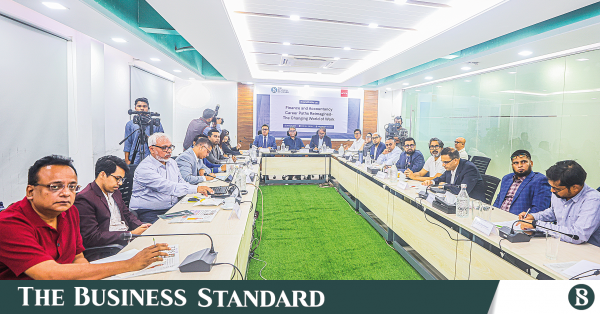
At a roundtable discussion titled “Finance and Accountancy Career Paths Reimagined – The Changing World of Work,” organised by ACCA Bangladesh at the office of The Business Standard, experts from regulation, academia, and industry collectively asserted that while the future of work is undeniably uncertain, it is teeming with opportunity for those willing to adapt
Experts discuss evolving finance and accountancy careers at a roundtable titled “Finance and Accountancy Career Paths Reimagined: The Changing World of Work,” jointly organised by The Business Standard and ACCA at the TBS conference room in Dhaka on 14 May. Photo: Mehedi Hasan
“>

Experts discuss evolving finance and accountancy careers at a roundtable titled “Finance and Accountancy Career Paths Reimagined: The Changing World of Work,” jointly organised by The Business Standard and ACCA at the TBS conference room in Dhaka on 14 May. Photo: Mehedi Hasan
The traditional landscape of the accountancy and finance profession is undergoing a seismic shift, moving away from a linear, knowledge-based past toward a hyper-personalised, technology-integrated, and purpose-driven future.
At a roundtable discussion titled “Finance and Accountancy Career Paths Reimagined – The Changing World of Work,” organised by ACCA Bangladesh at the office of The Business Standard, experts from regulation, academia, and industry collectively asserted that while the future of work is undeniably uncertain, it is teeming with opportunity for those willing to adapt.
The dialogue, moderated by TBS Senior Executive Editor Sharier Khan, highlighted that success in this new era will depend on the ability of professionals to combine deep technical expertise with human-centric skills such as empathy, curiosity, and strategic influence.

Dr Sajjad Hossain Bhuiyan, Chairman, Financial Reporting Council (FRC) Bangladesh and Dr ASM Amanullah, Vice-Chancellor, National University presented at the discussion as chief guest and special guest respectively.
Keynote paper: From ‘pyramids to diamonds’
Photo: Collected
“>

Photo: Collected
Clive Webb
Head of Business Management,
ACCA Global
Clive Webb, Head of Business Management at ACCA Global, presented the keynote paper, challenging the traditional “linear” view of career trajectories. Drawing from global research involving over 2,600 respondents, Webb noted that demography, climate, and technology are the three interconnected drivers reshaping the world.
“Historically, a profession was the owner of a body of knowledge. Today, knowledge is incredibly accessible,” Webb stated. “The role of the profession now is to add trust, integrity, and value-driven insight to that analysis.”
Webb described a transition from a traditional “pyramid” organisational structure – defined by many entry-level roles – to a “diamond-shaped” framework. In this model, AI and automation handle routine tasks at the bottom, while the workforce expands in the middle to focus on interpretation, human verification, and strategic decision-making. He noted that 67% of global respondents identify AI as the primary factor redefining their careers.
“We won’t necessarily progress through our careers in the future; we will progress across them,” Webb said, adding that by 2030, the “Fifth Industrial Revolution” – focussed on human-machine collaboration – will already be giving way to the sixth.
Photo: TBS
“>

Photo: TBS
Prawma Tapashi Khan, FCCA
Country Manager, ACCA Bangladesh
Prawma Tapashi Khan, Country Manager at ACCA Bangladesh, said, one of the primary reasons we have gathered today is the recognition that Bangladesh is navigating the same trajectory as the rest of the world regarding Artificial Intelligence. While there are valid concerns regarding job displacement, it is equally true that a multitude of new roles will emerge. The nature of work is being fundamentally redefined, and we must prepare ourselves for that shift.
We often hear that technology itself will not replace the human professional. However, individuals who fail to utilise technology effectively will almost certainly be replaced by those who do. In this globalised era, a professional no longer needs to move abroad to compete on the international stage; global work can be executed right here in Bangladesh. Yet, this requires significant preparation, mindset and an honest assessment of our readiness.
Photo: TBS
“>

Photo: TBS
Dr Sajjad Hossain Bhuiyan
Chairman – FRC Bangladesh
Voices from regulation and public Sector
Dr Bhuiyan highlighted a massive untapped employment field within the informal economy. “There are approximately 150,000 companies registered in Bangladesh, but only 35,000 submit tax returns. Where are the other 115,000 companies? Accountants have a vital role in finding them and bringing them into the formal fold.” He also stressed the need for a professional Valuation Code to prevent mortgage fraud and mentioned the council’s effort to bring 319 State-Owned Enterprises (SOEs) under proper accounting oversight.
Photo: TBS
“>

Photo: TBS
Dr ASM Amanullah
Vice Chancellor, National
University Bangladesh
Dr Amanullah pointed out a startling disconnect in the labour market. “Bangladesh produces 10 lakh graduates annually, yet three lakh remain unemployed. This is due to a lack of industry-academia linkage, which is as low as 10% in liberal arts.” He outlined 26 reform initiatives at National University, including an MoU with ACCA to integrate professional certifications into the curriculum, and called for increasing education spending to 3% of GDP.
Snehasish Barua, FCA, ACA (ICAEW)
Partner at Snehasish Mahmud & Co BD
Barua highlighted the “borderless” nature of the new economy. “Accountants in Bangladesh are now servicing global clients in the UK and USA. However, we have a critical shortage of specialists. For instance, eight out of ten client requests I receive are for forensic accounting, yet we have very few experts in that field.”
Shah M Mohin Uddin, FCA, ACMA, ACA (ICAEW)
Senior Partner, Hasan Mohin CA
Uddin argued that Bangladesh faces a “mindset crisis” rather than a job shortage. “Out of 150 applicants, barely 10 met professional standards. This gap is why we have 2,00,000 foreign professionals in our industries. Traditional degrees are no longer enough; you must think out of the box.”
Mohammad Rokibul Kabir
Dean, Faculty of Business & Entrepreneurship (FBE), Daffodil International University
Kabir said the industry should engage more actively with campuses. “Collaboration shouldn’t be ceremonial. We launched the ‘Pathway to ACCA’ and an MBA in Forensic Accounting specifically to meet market demands, proving that students can work and study simultaneously if the mindset is right.”
Shah Waliul Manzoor
Senior Business Development Manager, ACCA Bangladesh
Closing the session, Shah Manzoor reaffirmed ACCA’s commitment to staying ahead of the curve. “The integration of AI into our curriculum by 2027 is a key element of our strategy. By aligning learning with technology and employer needs, we are preparing agile professionals to lead in a rapidly evolving global economy. Resources like our Study Hub, Skills Hub, ACCA Learning, Careers, CPDs and Professional Insights reports are ensuring our community stays at the cutting edge of practice.”
Tanaka Islam
People Partner (Head of HR), Maersk (Bangladesh & Sri Lanka)
Islam stated that the era of preferring select universities is over. “We look for the right mindset. Degrees are secondary. I often see candidates try to present themselves as ‘perfectionists,’ but self-awareness of one’s own weaknesses is a much more valuable quality in a modern professional.”
Seezan M Choudhury, FCCA
Partner, ACE Advisory, Bangladesh
Choudhury noted that managing “Gen Z” requires accepting their desire for flexibility. “What we see as uncertainty, they see as flexibility. AI allows us to automate the bottom of the pyramid, enabling mid-level managers to provide high-quality reports that previously required massive technical teams.”
Imam Al Razi, FCCA
Director Finance, Growth & Strategy, Mostarlab Enterprise Solutions
Al Razi noted that the challenge often lies with business owners who fear automation. “98% of corporate emails are already being written with AI assistance. While the accuracy of learning models is currently 60-70%, it will be dangerous for those who do not adapt within the next three years.”
Marzana F Chowdhury, FCCA
Managing Director, RSM Bangladesh
Chowdhury emphasised that finance professionals must act as “co-pilots” to management. “We are moving from reporting the past to driving the strategy of the future. This requires soft skills – collaboration, communication, and the power to influence management.”
Jakir Hossain, FCCA
Group CFO, Asiatic 3Sixty, Bangladesh
Hossain described the transition of finance leaders from “historians” to “architects.” “I re-engineered our company’s financing structure and saved hundreds of crores. That wasn’t just technical bookkeeping; it was strategic integration. The ‘old guard’ must embrace digital trust and remote work to keep pace with the new generation.”
Arifur Rahman, FCCA
CEO – Emerging Credit Rating Ltd.
Rahman expressed concern over the “confused” nature of Gen Z entry into the workforce. “We see 50% no-show rates at interviews. There is a significant gap in ‘Bangladesh-centric’ knowledge – students don’t know how the local financial ecosystem or the central bank works. We need a collective effort to bridge this skill deficit.”
Mohsena Khanom Munna, FCCA
Founder, De Tempete
Munna highlighted the potential of the BPO sector. “Accounting BPO is a major export industry, but we lose investment when interns leave after six months. We need embedded technical courses in universities so graduates are ‘job-ready’ from day one.”
Mohammod Rashedul Alam Chowdhury, FCCA
Financial Management Officer, ADB
Chowdhury voiced concerns over the lack of specialised finance cadres in the public sector. “I have seen project accountants with backgrounds in unrelated subjects like Pali or Bengali. We need a holistic systemic change where Project Directors (PDs) for finance-heavy projects are required to have a background in accounting to ensure transparency and efficiency.”
Sarwar Alam, ACCA
Executive Partner, KZK Advisory
Alam focused on the SME sector. “Bangladesh has 78 lakh SMEs. They cannot all afford expensive ERPs or high-priced CAs. This is a massive market for accountants who can offer affordable, AI-assisted services.”
Shanshil Ahmed Shibly
Director Technology Grameenphone Ltd.
Shibly said, “For us, AI has already passed. It is not coming; it is already here.” He predicted that by 2027, the era of “Agent AI” will be in full swing, and by 2028, “Robotic AI” will handle most basic tasks. “Companies are transforming not just for profit, but for survival. Data sovereignty must become a national priority.”
Professor Tapan Mahmud
Head of the Dept. Department of Business Administration in Accounting & Information Systems, Faculty of Business Studies (FBS), Bangladesh University of Professionals (BUP)
Professor Mahmud said that Outcome-Based Education (OBE) must not become a mere paperwork exercise for accreditation. “Over-reliance on digital tools is eroding students’ decision-making abilities. We need ‘dialogic teaching’ that empowers students to handle complex scenarios that go beyond simple number-crunching.”
Labio Bala, FCCA
Financial Specialist, UNOPS
Bala concluded by stating that competency is the ultimate benchmark. “Your job doesn’t give you value; you add value to your job. You may have the degree, but if you lack the confidence to use technology and add value, you will be left behind.”
Scan the QR code to explore the ACCA report


Comments are closed.