Tech entrepreneur spells out vision for future of finance – The Royal Gazette
Created: May 14, 2026 07:59 AM (Updated: May 14, 2026 08:43 AM)
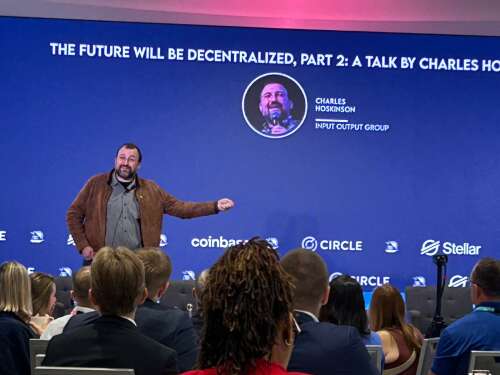
Decentralisation vision: Charles Hoskinson speaks at the Bermuda Digital Finance Forum (Photograph by Jonathan Kent)
Charles Hoskinson sees a future in which our phones effectively become our banks, enabling us to transfer digital money seamlessly and instantly around the world, without fees or bureaucratic friction.
Speaking at the Bermuda Digital Finance Forum, billionaire Mr Hoskinson, a technology entrepreneur and mathematician, spelled out why he believes “the future will be decentralised”.
In 2014, he gave a TEDx talk in Bermuda on the same topic and he reflected on how much had changed since.
“Back on that day, bitcoin was $375 and there were five million people worldwide who were using cryptocurrencies,” Mr Hoskinson, cofounder of Ethereum and Cardano, said. “There were less than 500 cryptocurrency projects, and cryptocurrency had just gone through the Mount Gox collapse.
“We were on the downtrend. Twelve years later, bitcoin is over $80,000 we have 560 million people using or holding cryptocurrencies. Over 50 million tokens have been issued. There’s 18,000 active projects worldwide.”
Mr Hoskinson’s recent focus has been on Midnight, a project aimed at enhancing data protection and compliance on blockchain, enabling real-world financial applications for broad use.
At its heart is a decentralised identifier — which can allow counterparties to verify key areas such as age, affiliations and investor category — without revealing additional unnecessary additional information.
“So you take this passport idea, you put it on the phone, and you make it so easy that in 60 seconds, it lives there the account, and it works with every chain,” Mr Hoskinson said.
“Counterparties know they’re allowed to do business with you, but they don’t know who you are. They don’t have your name. They don’t have any of these things because they don’t need to know these things in a global society.
“That’s how you prevent discrimination. That’s how you prevent people saying, ‘I just don’t like people from over there’.”
He described how bringing together the different blockchain-based financial infrastructures in a cohesive ecosystem was key to enabling broader adoption and everyday usage of digital assets.
“If it works through multichain signatures, then it means you can spend bitcoin, ethereum or stablecoins with it,” Mr Hoskinson said. “If it links all the systems together, then it creates fair competition between them. I firmly believe the future is going to be decentralised.”
In countries with large unbanked communities or economies with a history of double-digit inflationary surges, digital assets have proven especially attractive.
“My company has an office in Argentina — it’s a $700 billion economy, and there’s $100 billion of cryptocurrencies in it, mostly stable coins,” Mr Hoskinson said.
“All of our employees in Argentina refuse to be paid in a local currency. They want to be paid in stablecoin. We pay our rent there in stablecoin.”
He pointed out that about 30 per cent of the population in Vietnam uses or has used cryptocurrencies, and 32 per cent in Nigeria.
Just as he outlined in his 2014 Bermuda speech, Mr Hoskinson said blockchain had the power to bring financial services to the billions of people around the world who remain unbanked.
“We can do it a third way, not the American way, not the Chinese way, but the blockchain way, and the benefit is every single person gets brought in.
“We started with $5 billion. Now we’re at $2 trillion. You wake up another 12 years from now, we’ll be at $100 trillion and billions of people in our industry — a global system, no one can go back.
“You have to choose between closed systems and open systems, between standards for all or standards for few, and you have to make some decisions about where the regulations are going to go and how to write them.”


Comments are closed.