
Most people start investing with the same instinct: find something that’s growing and put money into it. It occasionally does. What doesn’t work is going without structure, because when the markets turn, one concentrated position can wipe out months of gains. Diversification is the antidote, but it’s not just about owning more things. It’s about having the right combination of things that don’t all fall at the same time. This article goes through practical strategies that beginners can use build an investment portfolio which is held together under pressure.
 Start with your risk profile, not your assets
Before you pick a single stock or bond, you should answer one honest question: How much loss can you take without panic selling? This is not a philosophical exercise. It determines everything about how your portfolio should be structured.
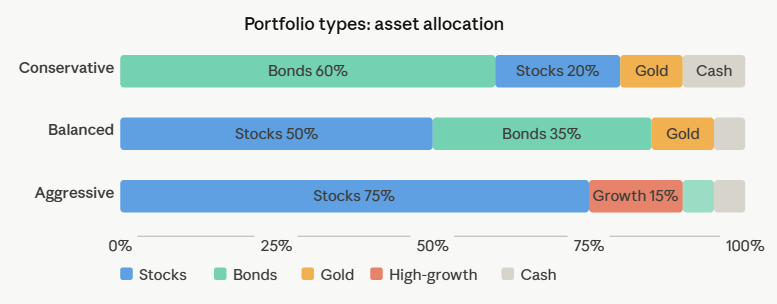
There are three basic types of portfolios. A conservative portfolio puts capital preservation first. Most of it is in bonds, gold and cash-like instruments. Returns are modest but steady, usually just ahead of inflation. A balanced portfolio is split roughly half into stocks and half into bonds and real assets. The returns are higher, but there are also withdrawals during bad years. An aggressive portfolio relies heavily on stocks, often 70% or more, including growth stocks or higher risk sectors. The advantage is significant in long horizons. As well as pain during corrections.
Your choice should also reflect your time horizon. If you need money in two years, being aggressive is the wrong answer regardless of your confidence in the market. The LiteFinance guide recommends a minimum period of three years for any serious investment portfolio. Shorter than that, and volatility starts working against you.
Basic principle: low correlation between assets
Diversification only works when assets do not move in step. Owning ten tech stocks is not diversification. They tend to fall together when the sector corrects. True diversification means combining assets whose returns are weakly correlated or even move in opposite directions.
A classic example is stocks and bonds. When stocks fall sharply during a recession, investors often rush into government bonds, pushing bond prices up. The two assets are partially offset. Adding gold further enhances this. Gold tends to hold back or rise during periods of currency stress or geopolitical uncertainty, precisely when stocks are struggling.
Real estate and commodities add another layer. Their returns are driven by a variety of factors: rent levels, construction cycles, supply and demand in physical markets. They don’t respond to the same triggers as a tech earnings report.
The practical takeaway: Before adding any asset to your portfolio, ask yourself not only if it will grow, but also how it will perform relative to what you already own.
Building a portfolio layer by layer
A portfolio for beginners doesn’t have to be complicated. Three layers cover most of what’s important.
The first layer is the foundation: broad exposure to stocks through index funds or ETFs that track major markets like the S&P 500 or a global stock index. This allows you to participate in long-term economic growth without trying to pick individual winners. It is low cost, easy to maintain and historically reliable over time horizons of five years or more.
The second layer is stability: bonds, either government or high-quality corporate. They reduce volatility, generate regular income and provide something to rebalance when stocks fall and become cheap. The proportion of bonds in your portfolio should roughly increase as your time horizon shortens.
The third layer is protection and alternatives: gold, real assets or small allocations for goods. They protect against inflation and currency risk. During periods when both stocks and bonds struggle, which happens, these assets often hold their value.
The table below shows how these layers move across the three main portfolio types:
| Asset class | Conservatively | Balanced | Aggressive |
| Stocks / Stock ETFs | 20% | 50% | 75% |
| Bonds | 60% | 35% | 5% |
| Gold / goods | 10% | 10% | 5% |
| Cash / short term | 10% | 5% | 5% |
| High growth / alternatives | 0% | 0% | 10% |
These are starting points, not rules. Your actual allocation should reflect your goals, time frame, and how you personally handle a 20% withdrawal.
 Rebalancing: A maintenance job that most people skip
A portfolio that is not rebalanced wanders. Stocks rise faster than bonds in bull markets, so after a few good years your 50/50 split quietly becomes 70/30. You are now taking on more risk than you intended without consciously choosing to do so.
Rebalancing means periodically selling what has risen above your target allocation and buying what has fallen below it. Annual is the most common approach and works well for most investors. Some rebalance when any asset class deviates more than five percentage points from the target.
The counterintuitive part is that rebalancing forces you to automatically sell high and buy low. When stocks have a strong year, short them. When the bonds are due, you add to them. This mechanical process imposes a discipline that most people cannot sustain emotionally.
Reinvesting dividends and interest in low-weighted assets is a way to rebalance without triggering major tax events from selling. Over long periods, this combined effect adds significantly to total returns.
Common mistakes made by beginners
The most common mistake is excessive concentration in famous names. Investors load up on companies they know and use every day, their phone manufacturers, their banks, their favorite retailers. It feels rational. The problem is that these companies often operate in related sectors and react similarly to economic shocks.
Another mistake is ignoring costs. The 0.05% annual fee ETF and the 0.95% fee ETF look similar on the chart today. Over twenty years, this difference translates into a significant gap in final yields. Keep costs low, especially for the base layer.
The third mistake is the reaction to short-term noise. A well-constructed diversified portfolio will underperform over certain periods compared to a concentrated bet on whatever is current. That’s by design. The goal is not the maximum return in any given year. That’s the best return you can get over your entire investment horizon without panic selling at the wrong time.
Conclusion
Diversifying a portfolio isn’t complicated, but it does require being honest about your goals and sticking to a structure when the markets get rough. Start with your risk tolerance and time horizon. Build three layers: growth assets, stability assets and protection assets. Choose them based on low correlation, not just recent performance. Rebalance at least once a year to keep your allocation on target. And resist the urge to chase last year’s winners. Portfolios that evolve quietly over time tend to outperform those built on excitement. The structure is what makes it work.